15 Things to Know Before Hiring a Pool Deck Resurfacing Orlando Company
A pool deck looks simple from a distance. Concrete, texture, color, a few expansion joints, and the space is done. That is how many owners approach it at first, especially if the immediate problem seems cosmetic. Then the bids arrive. One contractor says the surface only needs a fresh coating. Another points to hollow spots, movement, rust stains, loose coping, and failing waterline tile. A third offers a price so low it seems impossible to ignore.
That is the point where good decisions start to matter.
In Central Florida, pool surfaces take a beating. Heat, rain, shifting soils, heavy UV exposure, and constant moisture create problems that do not behave like a normal patio or walkway. A deck can look tired because of age, but it can also look tired because the slab underneath is moving, drainage is poor, or the bond between the deck and the coping has already failed. Hiring the right company is not just about getting a nicer finish. It is about understanding what is really happening around the pool shell and choosing a contractor who can fix the right problem.
If you are comparing companies for pool deck resurfacing Orlando homeowners commonly need, the details below will save you money, frustration, and do-overs.
Start by separating appearance issues from structural issues
The first thing to know is that resurfacing is not a cure-all. A new acrylic coating or decorative overlay can improve a worn deck dramatically, but it cannot solve deeper movement, settlement, drainage failure, or widespread cracking. A good contractor should spend more time inspecting the deck than talking about color charts.
Hairline shrinkage cracks in older concrete are common and often manageable. Wider cracks with vertical displacement are different. So are soft spots near skimmers, loose coping stones, or sections of deck that hold water for hours after rain. If a company treats every problem as a surface problem, be cautious.
I have seen owners pay for a beautiful new finish only to watch the same crack telegraph through the coating within a season. The contractor had not ignored the crack, exactly. He simply filled it like a paint prep issue when it was really a movement issue. The result looked good on day one and disappointing by month eight.
Orlando weather changes the job
A pool deck in Orlando does not live the same life as one in a drier climate. Afternoon storms, high humidity, intense summer sun, and warm temperatures over long stretches affect installation timing and material performance. Products cure differently here. Moisture levels matter. Scheduling matters too.
That is why local experience counts. A contractor who understands pool deck repair Orlando projects in this climate will talk with specificity about moisture, surface temperature, rain windows, and cure times. If the proposal reads like a generic coating sale, with no mention of weather conditions or seasonal timing, it may not reflect real field knowledge.
This comes up most often with decorative coatings and knockdown textures. Applied at the wrong time, they can flash cure, trap moisture, or fail to bond properly. None of that is theoretical in Florida. It happens.
Not every resurfacing system fits every deck
Resurfacing is a broad term. Some companies use acrylic lace systems. Others install polymer overlays, spray textures, microtoppings, or paver-style stamped finishes over existing concrete. Each system has strengths and limitations.
An acrylic coating can be attractive, cooler underfoot, and cost-effective for decks that are fundamentally sound. A thicker overlay may help hide minor imperfections better, but it also places more importance on proper prep and substrate stability. Stamped systems can look impressive, though they may not be ideal for every renovation budget or every existing slab condition.
Ask what system is being recommended and why. A serious contractor should explain the fit between the material and your deck’s condition, not just the finish and color. When I hear a sales pitch that begins and ends with appearance, I assume the underlying evaluation was thin.
Surface preparation is where most quality differences begin
Owners tend to compare colors, warranties, and square-foot pricing. Contractors know the project often succeeds or fails during preparation.
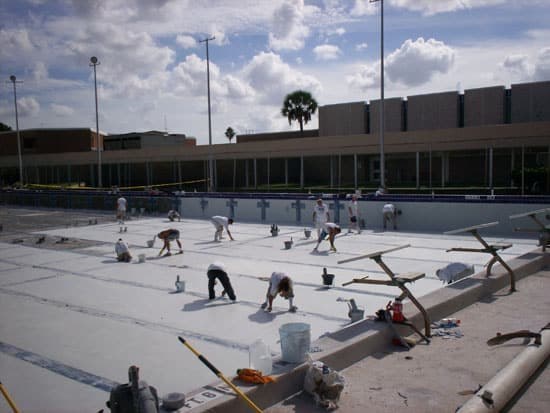
Preparation can include pressure washing, degreasing, crack treatment, mechanical grinding, scarifying, patching low spots, removing failed coatings, and profiling the surface for adhesion. If the existing deck has peeling layers from a prior resurfacing job, simply coating over them is risky. If calcium, sunscreen residue, efflorescence, or mildew remain embedded in the surface, bond problems can follow.
This is one area where the estimate should be detailed. “Prep as needed” is not a detail. It is a placeholder. The more vague the prep language, the more likely surprises will emerge after work starts, or worse, will never be addressed.
Cheap bids often leave out the hardest parts of the work
Low prices rarely appear by accident. They are usually the result of thinner prep, lower-grade materials, fewer repair allowances, or less experienced labor. Pool work is especially vulnerable to this because many defects are hidden under an existing coating or only become obvious once demolition begins around tile and coping.
If one bid is dramatically lower than the others, ask exactly what is excluded. Is crack repair limited? Are hollow or loose areas included? Does the price assume no drainage correction? What happens if coping is unstable? Does the contractor remove and replace mastic at expansion joints, or simply coat around it?
This does not mean the highest bid is automatically best. It means the lowest bid is often built on assumptions that favor the contractor, not the homeowner.
Cracks need diagnosis, not just filler
Almost every older deck has cracks. The important question is why.
Some cracks are cosmetic and stable. Others reflect deck movement, subgrade issues, root pressure, or thermal expansion problems. Repair methods vary. A flexible treatment may make sense in one area, while routing and filling with a different material may suit another. In some cases, the best answer is to honor the movement rather than pretend it will disappear under a coating.
A contractor experienced in pool deck resurfacing Orlando conditions should be willing to explain the likely cause of major cracks in plain language. If you hear vague reassurance such as “the coating will cover that,” press further. Good repairs begin with honest expectations. Even a very good resurfacing system cannot guarantee that a structurally active crack will never reappear.
Drainage can make or break the finished deck
A pool deck that holds water is more than an annoyance. Standing water leads to slippery conditions, staining, coating wear, and in some cases water intrusion around nearby structures or the pool beam area. If the deck already has birdbaths or broad low spots, resurfacing without correcting grade issues can preserve the problem with a newer appearance.
Drainage conversations should include where water currently goes during heavy rain, whether the deck slopes correctly away from the home, and whether local corrections are possible without creating awkward transitions at screen enclosures, doors, or the pool edge.
I have seen resurfaced decks with beautiful texture and color become visually blotchy within months because puddling kept certain areas wet and dirty. The owner blamed the finish. The real issue was slope.
Coping deserves as much attention as the deck
Homeowners often focus on the field of the deck and overlook the edge where the deck meets the pool. That edge matters. Coping takes stress from movement, splash-out, chemicals, and sun exposure. If it is loose, cracked, or poorly bonded, resurfacing the adjacent deck without addressing it can be shortsighted.
Sometimes coping is salvageable. Sometimes it should be reset or replaced. On renovations involving older pools, pool tile and coping replacement Orlando contractors perform can become the turning point that makes the whole area feel new and function correctly. The challenge is that coping replacement affects the schedule, budget, and sequencing of the entire project.
A reliable company will assess coping honestly instead of hoping you will not ask.
Tile problems are not always cosmetic either
Waterline tile often gets discussed as a style decision, but damaged tile can indicate more than dated taste. Cracked lines, missing grout, loose pieces, and hollow sounds may suggest bond failure or movement near the top of the pool shell. If tile is failing in isolated spots, local repair may work. If failure is widespread, a broader renovation may be warranted.
This is why pool tile replacement Orlando homeowners consider should be evaluated alongside deck work, not as a separate afterthought. New deck finishes next to old, failing tile create a mismatch in both appearance and longevity. It often makes financial sense to look at both scopes together when the symptoms overlap.
The same applies to pool tile and coping replacement Orlando projects where the pool perimeter has multiple signs of age at once. Doing one piece now and the other piece next year can sometimes be reasonable. It can also lead to duplicated mobilization costs and avoidable disruption.
Expansion joints and mastic are not small details
The flexible joint material between the deck and the coping, or between deck sections, is easy to ignore until it fails. When mastic dries out, cracks, or pulls away, water can get where it should not. That can contribute to subgrade erosion, deck movement, and deterioration around the pool edge.
Many resurfacing proposals barely mention joints. They should. Replacing failed joint material is not glamorous, but it is part of a proper renovation. If a contractor plans to coat right up to old, brittle mastic, the finish may look cleaner for a photograph than it will after a season of Florida weather.
Ask how joints will be treated, what material will be used, and whether old sealant will be removed first.
Licensing, insurance, and scope alignment matter more than many owners realize
Pool renovation work often sits at the intersection of concrete repair, surface finishing, tile work, and sometimes structural or plumbing-adjacent concerns. You want a company whose licensing and insurance align with the work being proposed. That sounds obvious, yet many disputes begin when an owner assumes a company handles everything in-house and later learns portions of the project are outsourced without much oversight.
Here are a few documents and answers worth seeing before signing:
- Proof of active licensing appropriate to the work scope
- General liability and workers’ compensation coverage
- A written breakdown of what is self-performed and what is subcontracted
- A payment schedule tied to progress, not vague milestones
- Warranty terms that define coverage and exclusions clearly
A professional company should provide these without defensiveness. If simple documentation becomes a struggle before the contract is signed, communication during the job is unlikely to improve.
Timelines should be realistic, not simply reassuring
Owners want speed, especially when the pool area is central to the home. Contractors know timing depends on weather, prep discoveries, cure windows, and coordination between trades. The best schedule is not the fastest one promised. It is the one the company can actually deliver.
A common mistake is believing that a short production timeline means better organization. Sometimes it means the company is assuming ideal conditions that rarely happen. Rain delays pool resurfacing orlando in Orlando are not unusual. Neither are hidden substrate issues once old materials come off. A credible schedule includes room for those realities.
Ask how many continuous workdays the project typically requires, what conditions can pause the job, and at what point the deck can handle foot traffic and furniture. If tile or coping work is involved, ask how sequencing affects pool use and startup afterward.
Warranties are useful, but workmanship matters more
A warranty can Classic Marcite pool resurfacing near me be valuable, but it is not a substitute for quality work. Read what it actually covers. Many coating failures that owners assume are warranty issues get attributed to substrate movement, drainage, existing concrete defects, or maintenance issues, all of which may be excluded.
The better approach is to judge the warranty alongside the contractor’s process. A company that explains prep thoroughly, documents deck conditions, and gives balanced expectations is usually more dependable than one offering sweeping promises. Long warranty language attached to vague installation practices should not reassure you.
When possible, ask how the company handles callbacks. That answer often reveals more than the written warranty itself.
Previous work should be relevant, not just attractive
Photo galleries are easy to curate. The important question is whether the company has completed projects like yours. A screened lanai pool with aged acrylic coating, minor settling, and loose waterline tile is not the same as a new build deck receiving a decorative finish for the first time.
Ask to see examples close in age, condition, and scope to your project. If you are considering pool deck repair Orlando services plus tile replacement, ask for completed jobs that included both. If your deck has coating failure from a prior resurfacing, ask how often the company deals with removals and bond failures.
Pretty pictures taken the day after completion tell only part of the story. The stronger signal is how the work is holding up after a year or two.
Communication during the estimate tells you how the job will go
Owners often focus so heavily on the product that they miss the service pattern already on display. Did the estimator inspect carefully or glance and quote? Did they answer direct questions, or pivot back to sales talking points? Was the written proposal specific? Did they explain possible contingencies without sounding alarmist?
Pool renovations involve surprises. Good communication does not eliminate them, but it prevents many disputes. The contractor who is clear early is usually clearer later, when dust, rain, and unexpected conditions complicate the schedule.
One of the most telling signs is whether the company can discuss trade-offs without pushing a single answer. Experienced professionals know that some owners should resurface, some should repair first, and some should expand the scope to include coping or tile. Judgment matters.
Maintenance after resurfacing should be part of the conversation
The work does not end when the crew leaves. Different finishes require different care, and those differences affect long-term appearance and service life. Some surfaces need gentler cleaning methods. Some sealers may need periodic renewal. Certain pressure washing practices can shorten the life of decorative coatings. Metal furniture, potted plants, and pool chemicals can all leave marks if handled carelessly.
Before hiring, ask what routine maintenance the finish needs and what should be avoided. A reputable contractor should give written care guidance. This is especially important when choosing among texture systems, color tones, and sealers, because the best-looking finish on day one is not always the easiest one to keep looking clean in a busy household.
The best contractor may recommend a bigger scope, or a smaller one
This is the final and perhaps most important point. Good contractors do not force every project into the same package. They understand restraint. Sometimes that means telling an owner the deck is not a good candidate for simple resurfacing. Other times it means steering the owner away from unnecessary demolition and toward targeted repairs that preserve budget.
That judgment is what separates a real renovation professional from a surface-level salesperson.
If your pool area has multiple symptoms, fading deck, loose coping, cracked tile, joint failure, recurring puddles, then the smartest path may be a coordinated renovation that addresses the perimeter as a system. If the slab is sound and the issues are mostly visual, a focused resurfacing project may be entirely appropriate. The point is not to spend more. It is to spend correctly.
Before you sign, keep these questions in mind:
- What problem is the company actually solving, surface wear or deeper deck failure
- How detailed is the preparation and repair scope in writing
- Are tile, coping, joints, and drainage being evaluated alongside the deck
- Is the schedule realistic for Orlando weather and cure conditions
- Does the company communicate with the clarity you would want once work begins
A pool deck renovation is one of those projects where experience shows up in small decisions. Surface prep. Crack judgment. Slope correction. Joint treatment. Material choice. Sequencing around tile and coping. Each may seem minor on its own. Together, they determine whether the finished deck still looks and performs well long after the startup photos are forgotten.
For homeowners weighing pool deck resurfacing Orlando services, that is the real goal. Not just a nicer color or a fresher texture, but a deck and pool perimeter repaired with enough care that the investment makes sense for years, not months.
Classic Marcite is a swimming pool contractor in Orlando, FL, resurfacing and renovating residential and commercial pools since 1988: marcite plaster, quartz, Pebble Tec and polished aggregate finishes, pool remodeling, pool deck resurfacing, tile and coping replacement, and pool repair.
430 Fairvilla Road, Orlando, FL 32808 · Serving Orlando, Windermere, Dr. Phillips, Winter Park, Maitland, Lake Mary and Heathrow
Phone: (407) 521-6260
Website: classicmarcite.com
Find us on Google Maps